

Python for Pharmaceutical Sciences
Couldn't load pickup availability
ISBN: 9788167081681
eISBN: 9788167081698
Author: Dr. Arpana Chaturvedi
Rights: Worldwide
Edition: 2027
Pages: 608
Dimension: 7.5*9.25 Inches
Book Type: Paperback
- Description
- Table of Contents
- About the Authors
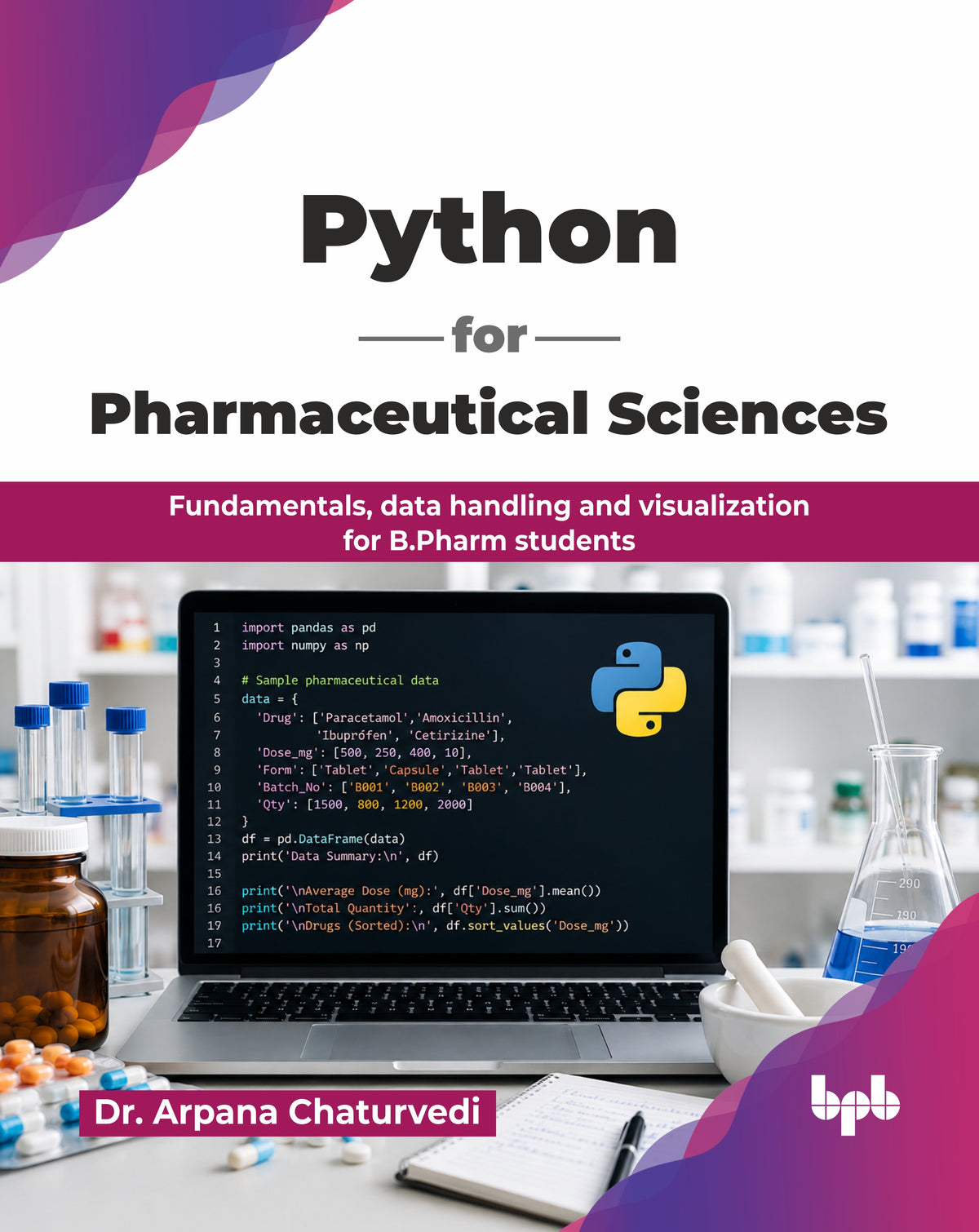
Python is increasingly used for scientific computing, data handling, automation, and reproducible analysis. In pharmaceutical sciences, it can support structured work with laboratory observations, formulation data, quality-control records, pharmacokinetic datasets, ADR reports, inventory information, and research data.
Python for Pharmaceutical Sciences introduces programming from the beginning for B.Pharm learners and is aligned with the core coverage of BP101T. It covers Jupyter Notebook, variables, data types, input/output, operators, strings, conditions, loops, functions, data structures, NumPy, file handling, Pandas, data cleaning, and Matplotlib. Each concept is supported with pharmacy-focused examples, algorithms, executable code, outputs, interpretations, exercises, and integrated projects.
By the end of this book, readers will be able to write basic Python programs, organize and analyze pharmaceutical datasets, automate routine calculations, and communicate findings through tables and visualizations. No prior programming experience is required; examples and datasets are intended for educational use.
WHAT YOU WILL LEARN
● Write code using variables, operators, input and output.
● Use conditions and loops to solve pharmacy problems.
● Manage data with lists, tuples, dictionaries and arrays.
● Create reusable functions for common pharmacy calculation tasks.
● Analyze data with NumPy, Pandas and Matplotlib tools.
WHO THIS BOOK IS FOR
This book is designed for B.Pharm and pharmaceutical science students beginning programming, as well as faculty members, researchers, quality-control trainees, and pharmacy professionals seeking practical Python foundations. No previous coding experience is required; familiarity with basic mathematics and common pharmaceutical terminology is sufficient.
1. Python and Pharmaceutical Sciences
2. Variables, Data Types, Type Casting, Operators and Input/Output Operations
3. Operators and Program Logic
4. Strings and Python Libraries
5. Decision-making with Conditional Statements
6. Loops and Repetitive Operations
7. Functions and Modular Programming
8. Python Data Structures
9. NumPy Arrays and File Handling
10. Data Handling with Pandas
11. Data Cleaning and Basic Analysis
12. Pharmaceutical Data Visualization with Matplotlib
13. Integrated Projects, Question Bank and Model Assessment
APPENDICES
Dr. Arpana Chaturvedi is an accomplished academician, educator, researcher, and technology professional with over three decades of experience in higher education, teaching, academic administration, curriculum development, and mentoring. She currently serves as Associate Professor and Head – IT (Data Analytics) at the New Delhi Institute of Management (NDIM), New Delhi.
She holds a Ph.D. in Computer Science, along with MCA, M.Phil. in Computer Science, and M.Sc. in Mathematics, reflecting a strong interdisciplinary foundation spanning mathematics, computing, and data analytics. Her doctoral research focused on security in Hadoop-based environments with reference to large-scale digital platforms such as DigiLocker and UIDAI.
Her academic and professional interests encompass Data Analytics, Artificial Intelligence, Machine Learning, Generative AI, Python, R, Advanced Excel, Power BI, Tableau, SQL, Database Technologies, Cybersecurity, Blockchain, and Big Data. Her teaching philosophy emphasizes connecting conceptual knowledge with hands-on learning, real-world datasets, business and industry applications, case studies, and problem-solving, enabling learners to understand not merely how a technology works, but why and where it should be applied.
She has extensive experience in academic leadership, course and curriculum design, faculty and student mentoring, research, training, assessment design, and technology-enabled education. She has designed and delivered learning experiences across programming, data analytics, visualization, emerging technologies, and digital tools for students and professionals from diverse academic Backgrounds.
A strong advocate of continuous professional development, she holds industry-oriented credentials in data analytics and visualization, including Microsoft Excel, Power BI (PL-300) and Tableau certifications. She has also contributed to innovation and intellectual property and is associated with a registered design patent.
Her academic journey is distinguished by a commitment to making complex technological concepts structured, practical, application-oriented, and accessible to learners. She is particularly passionate about interdisciplinary education and the application of computing and data analytics beyond traditional computer science domains, including management, business, healthcare, and pharmaceutical sciences.
Through her teaching, research, training, academic writing, and mentoring, she continues to promote data-driven thinking, digital competency, responsible use of emerging technologies, and lifelong learning. Her work reflects her belief that technology education becomes truly meaningful when learners can confidently transform theoretical concepts into practical solutions.