

Designing AI Data Centers
Couldn't load pickup availability
ISBN: 9789378541179
eISBN: 9789378545696
Authors: Scott Andersen
Rights: Worldwide
Edition: 2026
Pages: 326
Dimension: 7.5*9.25 Inches
Book Type: Paperback
- Description
- Table of Contents
- About the Authors
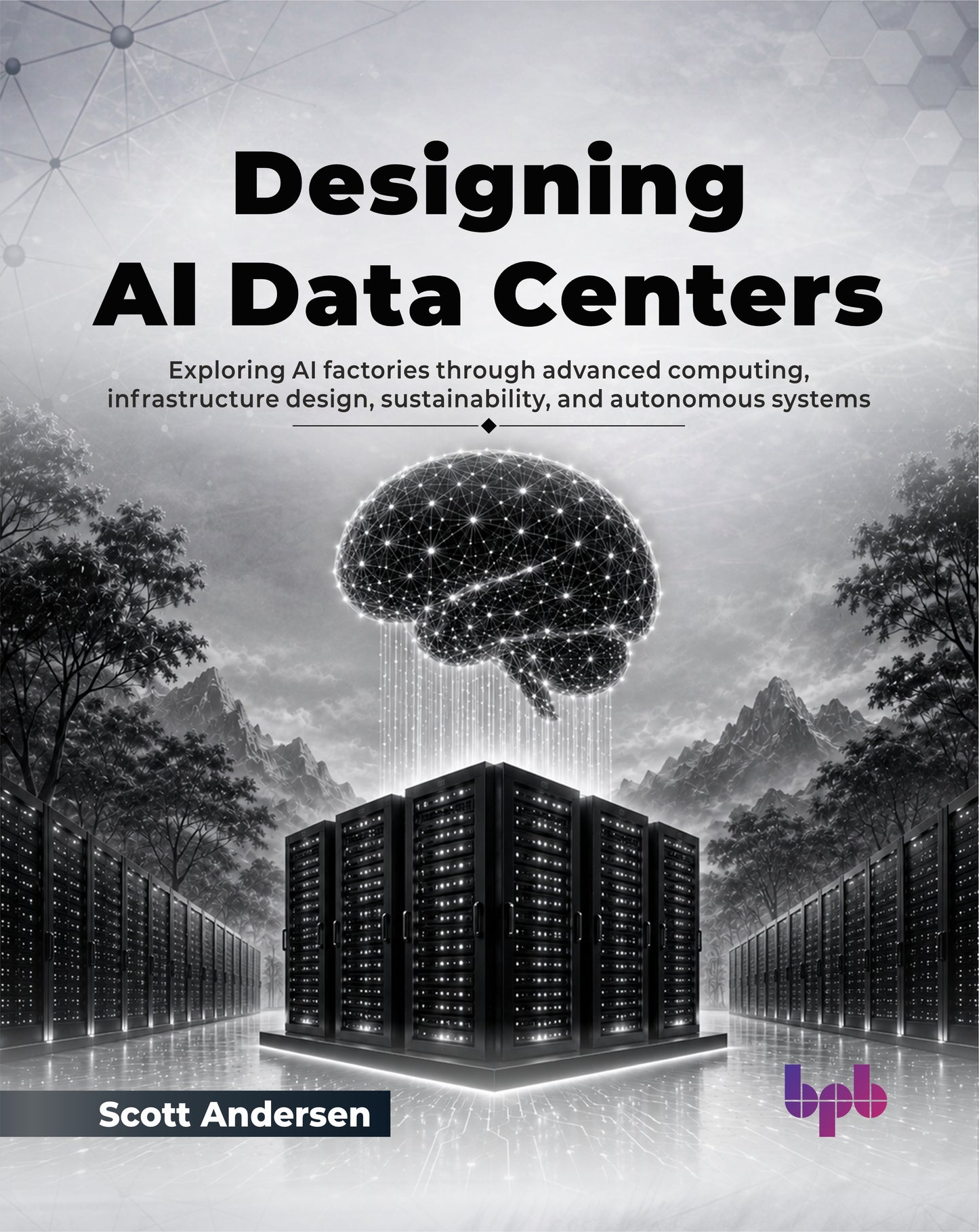
This book argues that AI is not simply software running on infrastructure; it is reshaping the infrastructure itself. As compute scales from megawatts to gigawatts, data centers evolve into AI factories, where energy, data, and silicon are fused into systems that continuously produce intelligence.
The book presents AI factories as the industrial backbone of the intelligence age, built on the foundational pillars of compute, network, power, sustainability, security, and governance. It moves from the foundations of AI factories, exascale computing, compute sovereignty, and efficient compute systems into multi-layered architectures, secure training systems, AI networking, power systems, autonomous grid systems, advanced cooling technologies, circular data centres, net-zero operations, modular construction, and water-neutral operations. Each chapter builds toward understanding how AI infrastructure is designed, operated, and governed as a living system.
By the end of this book, readers will gain a deeper understanding of the technical, operational, and strategic principles required to design and manage AI data centres. The book prepares leaders, architects, and innovators to navigate the future of intelligent infrastructure, where AI factories become essential systems for building, operating, and governing intelligence at scale, and where intelligence is manufactured, energy is cognition, and infrastructure itself begins to think.
WHAT YOU WILL LEARN
● Understanding how AI factories transform data centers into intelligence production systems.
● Learn AI factory foundations, exascale computing, and intelligent infrastructure design.
● Explore efficient compute architectures, hybrid systems, and sustainable AI acceleration.
● Learn power systems, autonomous grids, and energy orchestration strategies.
● Understand how energy, water, and carbon shape AI infrastructure decisions.
● Learn practical strategies to design, scale, and operate AI infrastructure at scale.
WHO THIS BOOK IS FOR
This book is intentionally written for both technical and business audiences because AI infrastructure is no longer just an engineering problem; it is a strategic and operational one. It is designed for architects, engineers, AI professionals, executives, infrastructure leaders, and sustainability experts shaping adaptive infrastructure. At its core, the book is for anyone responsible for making decisions where infrastructure, intelligence, and strategy intersect.
1. Foundations of the AI Factory
2. Designing Efficient Computing for Intelligent Systems
3. Designing Sustainable AI Systems
4. Architecting Multi-Layer AI Systems
5. Secure Architecture for Scalable Training
6. Networking Foundations for AI Data Centers
7. AI-Optimized Power Systems
8. Autonomous Grids for AI Data Centers
9. Advanced Cooling Systems for Exascale
10. Circular Data Centers for AI Operations
11. Data-Driven Management for Net-Zero Operations
12. Computational Methods for Modular Construction
13. Designing Water-Neutral AI Operations
14. Implementation and Phased Transition
15. Autonomous Infrastructure and Ethical Governance
Scott Andersen is a distinguished architect and AI infrastructure strategist with nearly three decades of experience across enterprise and federal environments. He has driven more than $7 billion in technology initiatives at organizations including Microsoft, Verizon, Lockheed Martin, and Accenture.
His work focuses on designing AI-native systems where compute, networks, and energy operate as a unified, intelligent infrastructure. Andersen has advised agencies such as the Department of Defense, Department of Homeland Security, and the Federal Aviation Administration on AI strategy and modernization.
As a published author and thought leader, he explores the rise of AI factories, intelligent networks, and the transformation of infrastructure into adaptive systems. His work reflects a core belief that artificial intelligence is not just a technology shift but a fundamental restructuring of how organizations and societies operate.