

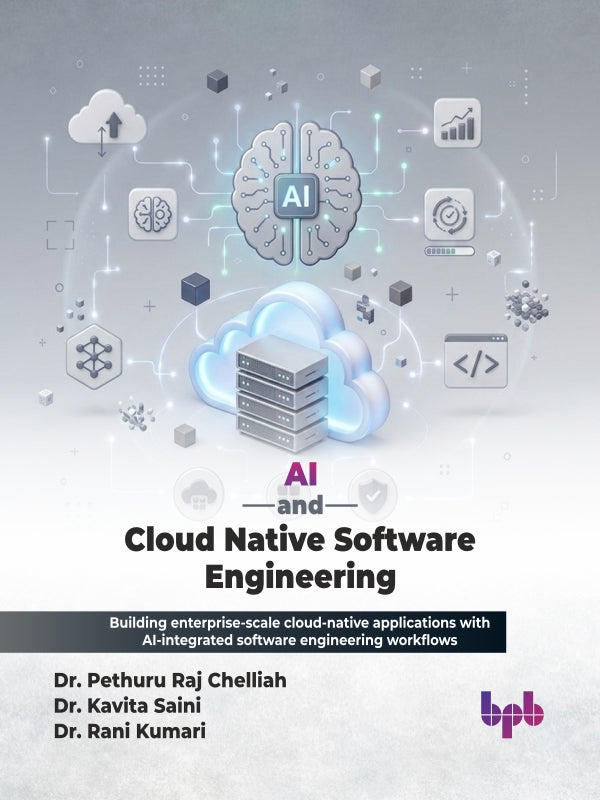
AI and Cloud Native Software Engineering
Couldn't load pickup availability
ISBN: 9789378540479
eISBN: 9789378549618
Authors: Dr. Pethuru Raj Chelliah, Dr. Kavita Saini, Dr. Rani Kumari
Rights: Worldwide
Edition: 2026
Pages: 242
Dimension: 7.5*9.25 Inches
Book Type: Paperback
- Description
- Table of Contents
- About the Authors
Artificial intelligence is the driving force behind the next generation of software, transforming how we build, deploy, and manage cloud-native applications. This book explores the powerful convergence of artificial intelligence, machine learning, and cloud-native software engineering, offering readers a practical understanding of how modern technologies are transforming software development. It highlights how AI-driven approaches are enhancing productivity, improving decision-making, and enabling smarter, scalable systems.
Readers will gain insights into how artificial intelligence empowers software engineering practices, including intelligent automation, predictive analytics, and improved software quality. The book also covers emerging areas such as generative AI for source code creation and advanced AI tools that assist developers in writing, optimizing, and maintaining code efficiently.
By the end of this book, readers will possess a comprehensive roadmap for upgrading their technical skills and adapting to the rapid evolution of industry demands. Readers will be equipped to enhance their professional impact by strategically leveraging AI-enabled tools, accelerating development lifecycles, and building innovative, cloud-native applications with confidence.
WHAT YOU WILL LEARN
● Explore generative AI techniques for automated source code creation.
● Learn popular AI tools for efficient software development processes.
● Apply machine learning models to improve software quality assurance.
● Design scalable applications using cloud-native architecture principles.
● Enhance productivity with intelligent automation in coding practices.
WHO THIS BOOK IS FOR
This book is for students, software developers, data scientists, cloud engineers, and IT professionals who want to integrate AI and ML into modern software development practices. It is also valuable for tech leads, researchers, and architects aiming to build scalable, intelligent, and cloud-native applications in evolving industry environments.
1. Technical Perspective of AI for Ensuring Knowledge Era
2. Empowering Software Engineering with Artificial Intelligence
3. Artificial Intelligence for Application Modernization and Migration
4. Generative and Agentic AI Principles and Practices for Accelerated Software Engineering
5. Study on AI Tools That Can Generate Software Source Code
6. AI-powered Tools to Enhance the Stages of Software Development
7. AI for IT Infrastructure Resource Optimization
8. AI and Workload Infrastructure Optimization
9. Challenges of Using AI in Software Development
10. Next-generation Developer Experience Enabled by AI
11. Coding to Prompting an Agentic AI Revolution
● Dr. Pethuru Raj Chelliah is a principal AI architect at Infocion Inc., Bangalore. Previously, he worked as the vice president and chief architect at the AI division of Reliance Jio Platforms Ltd., Bangalore, IBM Global Cloud Centre of Excellence (CoE), Wipro Consulting Services (WCS), and Robert Bosch Corporate Research (CR). He has gained over 25 years of experience in the IT industry and nine years of research experience. He has finished the CSIR-sponsored Ph.D at Anna University, Chennai. He continued with UGC- sponsored postdoctoral research in the department of computer science and automation at the Indian Institute of Science (IISc), Bangalore. After that, he got two international research fellowships (JSPS and JST) to work as a research scientist for 3.5 years in two leading Japanese universities.
He focuses on emerging technologies, including generative and agentic AI, AI model optimization techniques, Cloud of Things (CoT), cloud-native and edge computing paradigms, platform engineering, 6G communication, and blockchain technologies, as well as quantum-safe cryptography algorithms. He has authored and edited over 75 technology books, published more than 60 research papers, and contributed to more than 55 book chapters.
● Dr. Kavita Saini is presently working as a professor and program chair , School of Computing Science and Engineering, Galgotias University, Delhi NCR, India. She received her Ph.D degree from Banasthali Vidyapeeth, Banasthali. She has 22 years of teaching and research experience supervising masters and Ph.D scholars in emerging technologies.
She has published more than 130 research papers in national and international journals and conferences. She has published 20 authored books for UG and PG courses for a number of universities, including MD University, Rohtak, and Punjab Technical University, Jallandhar, with national publishers. Kavita Saini has edited more than 20 books with international publishers including Elsevier, IET Publisher , IGI Global and CRC Press , Nova Science Publishers and published 30 book chapters with international publishers. Under her guidance many M.Tech. and Ph.D(CS) scholars are carrying out research work and few have completed under her guidance.
Kavita Saini has also delivered technical talks on blockchain: an emerging technology, web to deep web and other emerging areas and handled many special sessions in international conferences and special issues in international journals. Her research interests include smart and sustainable agriculture, blockchain technology, Industry 5.0, cloud and edge computing, digital twin, and web-based instructional systems.
● Dr. Rani Kumari is currently working as an assistant professor at IILM University, Greater Noida, India. She is pursuing her post-doctoral research in machine learning from Lincoln University College, Malaysia. She completed her Ph.D. in computer science from Galgotias University and has qualified UGC-NET.
She has over 5 years of experience in the software industry, working as a software engineer and developer, along with more than 1.3 years of teaching experience in higher education. Her industry experience includes end-to-end software development, testing, and web- based application development.
Rani has published several research papers in reputed national and international journals and conferences. Her research contributions focus on artificial intelligence, machine learning, data mining, and predictive analytics, particularly in the domain of manufacturing and Industry 4.0 applications. She has also filed two patents in the field of IoT-based smart systems and agricultural technologies.
Her research interests include artificial intelligence, machine learning, predictive analytics, data mining, smart manufacturing, Industry 4.0, and IoT-based systems. She is actively involved in academic research, teaching, and developing innovative solutions for real- world industrial problems.
She is proficient in programming languages such as Python, C, C++, and web technologies including PHP, HTML, CSS, and JavaScript. Her technical expertise also includes database management systems like Oracle and SQL Server, along with strong knowledge of operating systems, networking, and UNIX.