

Cloud AI Architect
Couldn't load pickup availability
FREE PREVIEW
ISBN: 9788167087027
eISBN: 9788167087065
Authors: Venkata Srinivas Kantamneni, Manideep Kantamneni
Rights: Worldwide
Edition: 2027
Pages: 338
Dimension: 7.5*9.25 Inches
Book Type: Paperback
- Description
- Table of Contents
- About the Authors
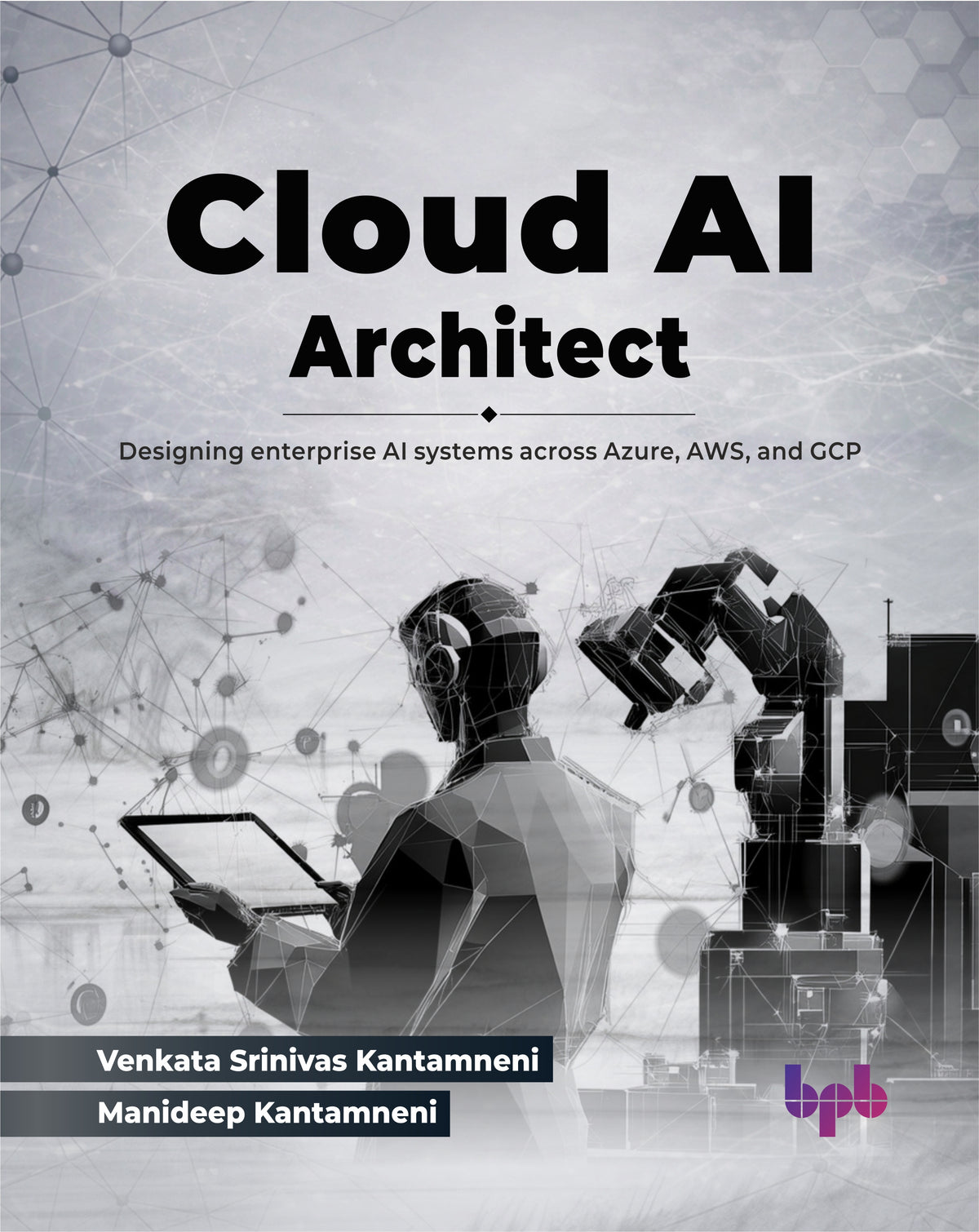
Enterprise AI has moved out of research notebooks into production, running on cloud infrastructure that demands a specialized multi-cloud strategy. This book is your definitive architectural roadmap to designing, building, and operating production-ready artificial intelligence solutions across Microsoft Azure, AWS, and Google Cloud Platform without vendor lock-in.
This book systematically covers the complete multi-cloud AI lifecycle across twelve detailed chapters. It begins with core infrastructure—GPU compute, petabyte-scale storage, private subnets, and SRE resilience—then layers on Zero Trust identity, enterprise governance, and cost management alongside LLM inference optimization. It moves through a managed platform overview comparing Azure OpenAI, AWS SageMaker, and Google Vertex AI, leading directly into hands-on model development, feature engineering, and AutoML pipelines. Later chapters cover domain-specific architectures for enterprise vision, natural language, and predictive forecasting, along with no-code/low-code tools like Power Automate and Textract.
By the end of this book, you will be able to design AI systems that are fast, affordable, governed, and resilient, and to defend every architectural choice with evidence rather than vendor claims.
WHAT YOU WILL LEARN
● Optimize GPU compute, storage, and networking for AI workloads.
● Enforce Zero Trust identity, governance, and compliance across three clouds.
● Build and deploy models on Azure ML, SageMaker, and Vertex AI.
● Design production vision, language, and forecasting systems end-to-end.
● Ship faster with no-code and low-code AI tooling.
WHO THIS BOOK IS FOR
This book is written for students, cloud architects, machine learning engineers, site reliability engineers, data platform leads, and engineering managers accountable for AI systems in production. Comfort with cloud fundamentals and Python will help, but no prior experience building an AI platform is assumed.
1. Core Cloud Infrastructure for AI Workloads
2. Identity, Governance, Compliance and Access Control
3. Cost Management, Monitoring, and Operational Excellence
4. Overview of Azure, AWS, GCP, the AI Platforms
5. Hands-on Model Building with Azure and AWS
6. Model Development with GCP Vertex AI and AutoML
7. Enterprise Vision AI Architecture
8. Enterprise Language and Conversational AI Architecture
9. Predictive Analytics and Forecasting Architecture
10. No-code and Low-code AI Engineering
11. Benchmarking and Platform Selection
12. Multi-cloud AI Architecture and Future Trends
Venkata Srinivas Kantamneni is a senior engineering leader specializing in multi-cloud architecture and advanced reliability engineering for mission-critical platforms in highly regulated financial services. Operating at the intersection of cloud-native resilience and AI- enabled operations, his expertise focuses on architecting fault-tolerant distributed systems, telemetry-driven observability, and autonomous remediation under immense production workloads. A thought leader with pending patents in cloud systems architecture, he champions the evolution of traditional site reliability engineering (SRE) into AI-native paradigms. He leverages this deep operational rigor to anchor the infrastructure, hyperscale compute, compliance, and Azure frameworks presented in this book.
Manideep Kantamneni is a distinguished engineering leader and architect who specializes in bridging the gap between platform engineering and applied AI. With a rich background in scaling full-stack architecture for massive enterprises, he currently leads the development of AI-enabled knowledge graphs and enterprise search systems. As an author, Manideep provides a practical blueprint for modern engineering exploring how teams adopt AI, how technical governance keeps pace with unprecedented speed, and why successfully scaling AI is ultimately an architectural challenge rather than a modeling one.