

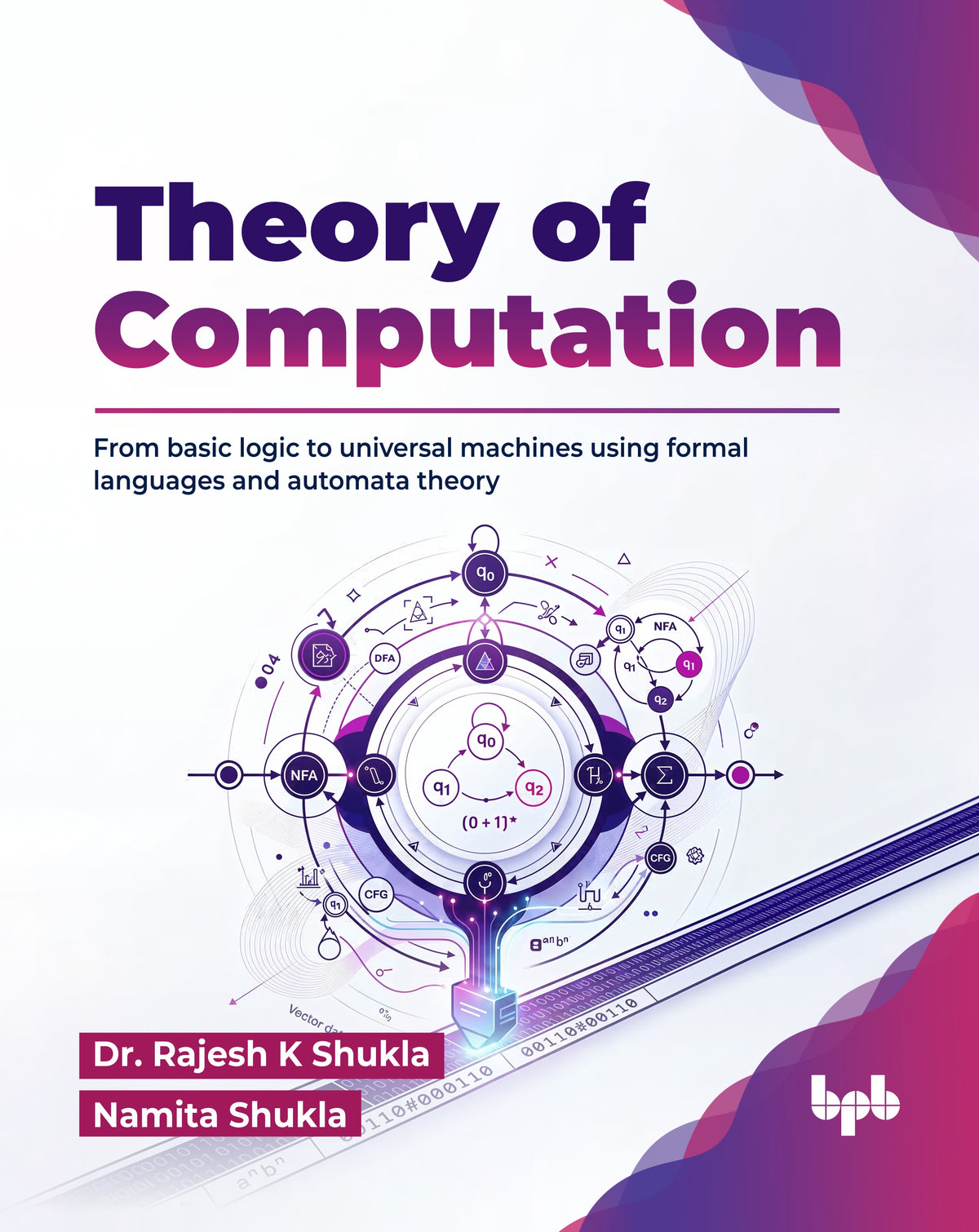
Theory of Computation
Couldn't load pickup availability
ISBN: 9789378542060
eISBN: 9789378546785
Authors: Dr. Rajesh K Shukla, Namita Shukla
Rights: Worldwide
Edition: 2027
Pages: 390
Dimension: 7.5*9.25 Inches
Book Type: Paperback
- Description
- Table of Contents
- About the Authors
This book forms the mathematical and logical foundation of modern computer science and plays a vital role in the design of intelligent and efficient computing systems. In today’s era of AI, compiler construction, cyber security, ML, data science, and advanced software engineering, understanding formal languages, automata, and computational complexity has become increasingly important in day-to-day life. The concepts of automata and computation theory are widely applied in algorithm design, programming language development, pattern recognition, NLP, and system optimization.
This book provides a comprehensive and systematic introduction to the fundamental concepts of computation. It begins with finite automata, regular expressions, and regular grammars, enabling readers to understand the basics of pattern recognition and language processing. It further explores context-free grammars and pushdown automata, which are essential for syntax analysis and compiler design. Advanced topics such as Turing machines, recursive and recursively enumerable languages, undecidability, Chomsky hierarchy, linear bounded automata, and computational complexity are discussed in a simple and structured manner.
By the end of this book, readers will gain a strong theoretical foundation in computation and develop the ability to analyze computational problems using formal methods. The book empowers you to analyze algorithms critically and solve complex computational problems in real-world computer science applications.
WHAT YOU WILL LEARN
● Understand fundamentals of automata, languages, and computational theory.
● Design and analyze finite automata.
● Apply regular expressions and grammars in language processing tasks.
● Develop context-free grammars and pushdown automata systematically.
● Strengthen logical reasoning through solved examples and practical exercises.
● Build foundations for compiler design and advanced computing systems.
WHO THIS BOOK IS FOR
This book is designed for undergraduate and postgraduate computer science students, compiler designers, software developers, and AI professionals. Readers should have a foundational knowledge of basic discrete mathematics, introductory programming logic, elementary data structures, and basic algebra.
1. Mathematical Preliminaries
2. Finite-state Automata
3. Finite-automata with Output
4. Regular Expressions
5. Context-Free Grammars
6. Pushdown Automata
7. Turing Machine
8. Undecidability
9. Intractable Problems
Dr. Rajesh K Shukla is the Director of Oriental Institute of Science and Technology, affiliated with Rajiv Gandhi Proudyogiki Vishwavidyalaya, the State Technological University of Madhya Pradesh. He holds a Ph.D. in Computer Science and Engineering from RGPV Bhopal and possesses more than 24 years of teaching and academic administrative experience across reputed engineering institutions. His research interests include Machine Learning, Data Science, Artificial Intelligence, and emerging computing technologies.
Dr. Shukla has made significant contributions to academics, research, and technical education through teaching, research supervision, and scholarly publications. He has authored seven textbooks published by reputed publishers including Wiley India, Cengage Learning, and BPB Publications, and has edited more than seven conference proceedings published by Springer Nature and IEEE. He holds seven granted patents with two additional patents published, reflecting his active involvement in innovation and applied research. In recognition of his academic excellence and contributions to technical education, he received the prestigious ISTE UP Government National Award in 2015.
An active member of the global academic and professional community, Dr. Shukla has served as a program committee member and co-chair for numerous international conferences and workshops. He has also initiated and organized several annual conferences, symposiums, and technical events, and regularly reviews research papers for reputed international journals. He is the Founding Chairman of the ACM Bhopal Chapter and former Chairman of the CSI Bhopal Chapter. Dr. Shukla is a Fellow of IETE, a Senior Member of ACM and IEEE, and a Life Member of ISTE, CSI, and IE(I). Through his academic leadership and research contributions, he continues to inspire students, researchers, and professionals in the field of computer science and engineering.
Namita Shukla is a Software Engineer at Cognizant with expertise in software development, computational theory, and emerging intelligent technologies. She holds an M.E. in Software Engineering from Institute of Engineering and Technology, DAVV and is currently pursuing her Ph.D. in the field of Computer Science and Engineering. Her academic and professional interests focus on Theory of Computation, Programming Languages, Machine Learning, and Data Science.
With a strong blend of industry exposure and academic involvement, Ms. Shukla has been actively engaged in exploring advanced computational techniques and modern software technologies. Her areas of expertise include formal languages and automata theory, programming methodologies, intelligent systems, and data-driven computing applications. She is passionate about bridging theoretical computer science concepts with real-world technological solutions.
Through her research and professional contributions, Shukla continues to work towards developing innovative approaches in machine learning and computational systems. Her dedication to continuous learning, technical excellence, and emerging research domains makes her an active contributor to the field of computer science and modern computing technologies.