

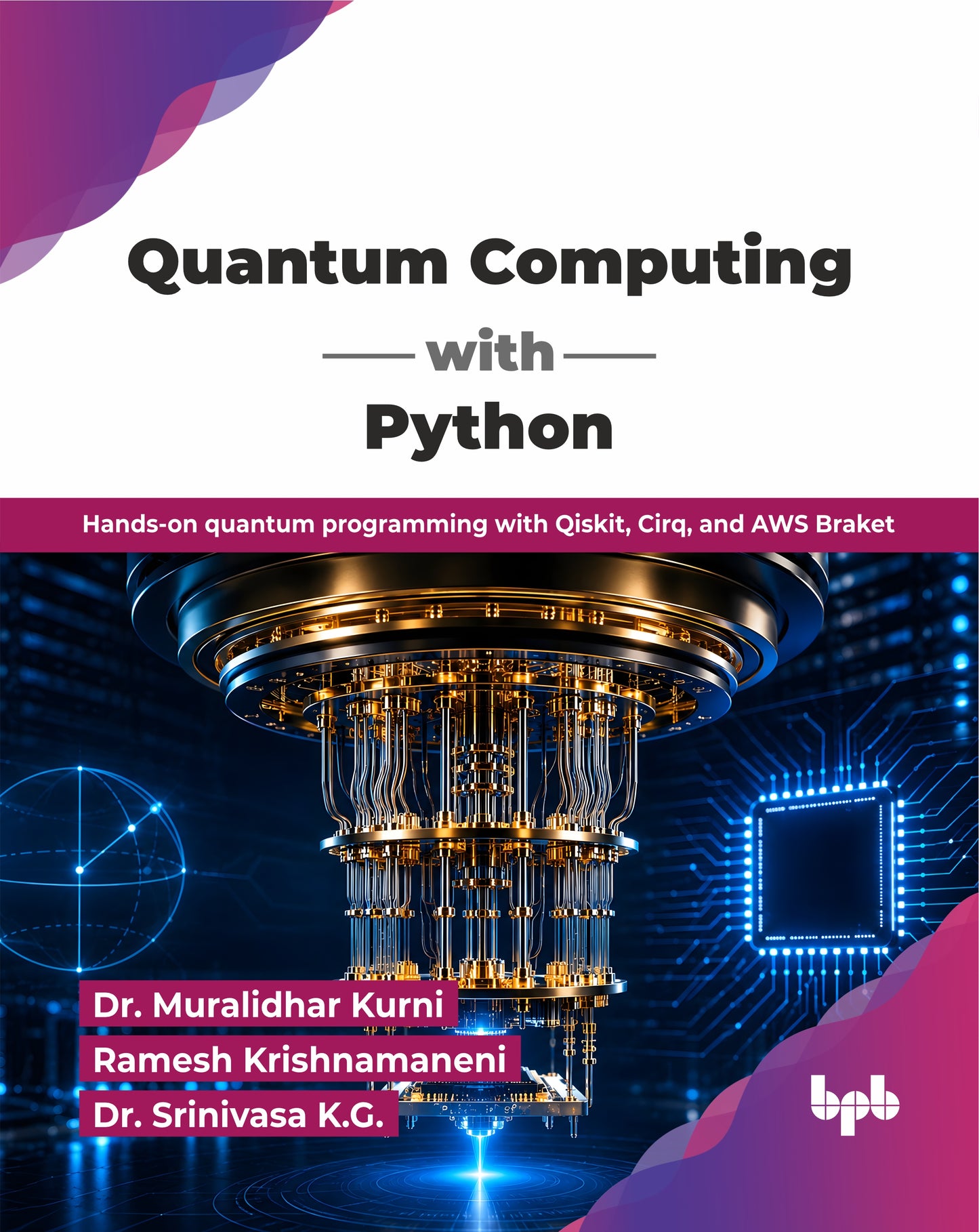
Quantum Computing with Python
Couldn't load pickup availability
ISBN: 9789378543609
eISBN: 9789378547652
Authors: Dr. Muralidhar Kurni, Ramesh Krishnamaneni, Dr. Srinivasa K.G.
Rights: Worldwide
Edition: 2026
Pages: 396
Dimension: 7.5*9.25 Inches
Book Type: Paperback
- Description
- Table of Contents
- About the Authors
Quantum computing is rapidly evolving from a theoretical concept into a practical technology, influencing areas such as cybersecurity, optimization, artificial intelligence, and scientific research. As industries explore their potential, there is a growing demand for engineers, developers, and researchers who can understand and apply quantum computing using accessible tools such as Python.
This book is written from a combined perspective of teaching, research, and industry experience, ensuring both conceptual clarity and practical relevance. It introduces core concepts such as qubits, quantum states, gates, and circuits, and then progresses to algorithms such as Grover’s and Shor’s. It also explains quantum hardware, noise, and real-world limitations. You will gain hands-on experience using Qiskit, Cirq, and AWS Braket, along with exposure to advanced topics such as variational algorithms, quantum cryptography, and quantum machine learning, supported by simulation exercises and mini projects.
By the end of this book, readers will be able to design and implement quantum programs, work with modern quantum platforms, and apply quantum concepts to real-world problems with confidence.
WHAT YOU WILL LEARN
● Understand qubits, superposition, entanglement, and quantum computing basics.
● Design quantum circuits using gates, measurements, and circuit models.
● Implement quantum algorithms like Grover’s and Shor’s using Python.
● Work with Qiskit, Cirq, and AWS Braket for real applications.
● Debug and optimize quantum code using generative LLMs.
● Train hybrid quantum neural networks with PennyLane PyTorch.
WHO THIS BOOK IS FOR
This book targets students, academicians, software developers, researchers, data scientists, and engineers with basic Python and introductory mathematics. It helps industry professionals develop practical skills in quantum programming, multi-framework SDK deployment, and real-world quantum computing applications.
1. Introduction to Quantum Computing
2. Qubits and Quantum States
3. Quantum Gates and Circuits
4. Quantum Algorithms
5. Quantum Hardware and Noise
6. Getting Started with Python for Quantum Computing
7. Programming with Qiskit from IBM
8. Quantum Utility and Qiskit Patterns
9. Programming with Cirq
10. Programming with AWS Braket
11. Variational and Hybrid Algorithms with Python
12. Quantum Cryptography and Security
13. Quantum Machine Learning
14. Quantum Simulation Projects
15. End-to-end Mini Projects
16. Artificial Intelligence and Quantum Computing
17. Road Ahead for Quantum Computing
Appendix: AI-assisted Programming for Quantum Computing
Dr. Muralidhar Kurni has more than 25 years of experience in teaching, research, and academic leadership, and is currently serving as an associate professor in the department of computer science and engineering and as dean of Research & Development (R&D) at Anantha Lakshmi Institute of Technology & Sciences (Autonomous), Anantapuramu, India. He holds a Ph.D. in computer science and engineering from JNTUA and has completed postdoctoral research at the University of South Florida, USA. His areas of expertise include AI, ML, high-performance computing, and quantum computing. A Senior Member of IEEE and an International Engineering Educator (IGIP), he has authored and edited several books with leading publishers. He has published extensively in reputed SCIE and Scopus-indexed journals. Through his teaching, research, and workshops, he has consistently focused on making complex computing concepts accessible, with a strong emphasis on Python-based learning and practical quantum computing education.
Ramesh Krishnamaneni has over 18 years of experience in software engineering, cloud architecture, and emerging technologies, and has played key roles as a solutions architect at IBM. He has led and delivered enterprise-scale solutions across IBM Cloud, AWS, Azure, and Red Hat OpenShift, enabling organizations to build scalable and intelligent systems. His expertise spans high-performance computing, AI, and quantum computing, with a strong focus on practical implementation using Python-based frameworks such as Qiskit and Cirq. He holds an M.S. in Software Systems from BITS Pilani and has completed advanced training in AI and ML from the University of Texas at Austin. He has contributed to research and technical work in AI-driven analytics, IoT, and advanced computing domains, and actively explores how to integrate quantum computing into real-world applications through modern programming approaches.
Dr. Srinivasa K. G. has over two decades of experience in teaching, research, and academic leadership, and is currently serving as professor of data science and AI and dean (academics) at DSPM IIIT-Naya Raipur, India. He holds a Ph.D. in computer science from Bangalore University and has served at several reputed institutions, including NITTTR Chandigarh, MSRIT Bangalore, and CBP Government Engineering College, New Delhi. A Senior Member of IEEE and ACM, he has authored numerous books and published more than 150 research papers in international journals and conferences. His expertise includes AI, high-performance computing, and emerging quantum technologies. He is a recipient of prestigious awards, including the AICTE Career Award, ISTE Best Research Award, IEI Young Engineer Award, and the BOYSCAST Fellowship from the department of science and technology, government of India. He actively contributes to advancing research and education in next-generation computational systems, including quantum computing.