

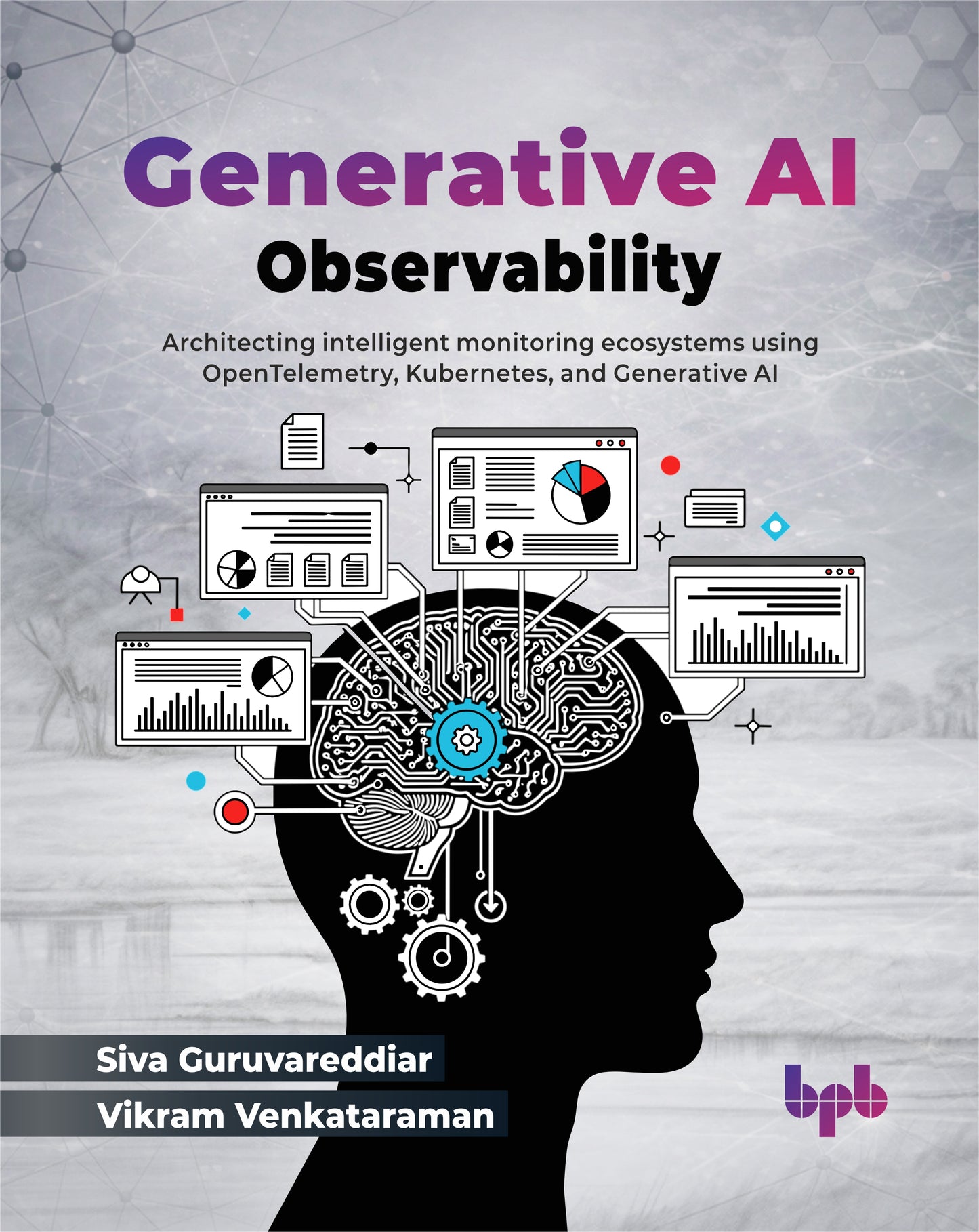
Generative AI Observability
Couldn't load pickup availability
ISBN: 9789378548871
eISBN: 9789378543203
Authors: Siva Guruvareddiar, Vikram Venkataraman
Rights: Worldwide
Edition: 2026
Pages: 280
Dimension: 7.5*9.25 Inches
Book Type: Paperback
- Description
- Table of Contents
- About the Authors
Modern software systems do not fail in simple ways anymore. They run across clouds, regions, containers, functions, and sometimes edge devices, all interacting at speeds humans cannot easily reason about. Traditional monitoring still has value, but on its own, it often falls short of explaining why something broke or what actually matters in the moment. As architectures grow more distributed and AI-driven, observability has shifted from basic signal collection to interpretation, context, and decision support.
The book takes you on a step-by-step engineering journey, starting with core observability architectural principles and data-driven monitoring strategies. You will master OpenTelemetry, handling context propagation and advanced tracing techniques across complex microservices and Kubernetes monitoring environments. From there, you will learn to optimize an open-source intelligent monitoring toolchain featuring Prometheus, OpenSearch, Grafana, and Jaeger. We will also learn how generative AI is being applied in real environments to interpret incidents, reduce noise, and support operational judgment, including where it helps and where caution is still needed.
By the end of this book, the readers will be fully equipped to deploy a secure, scalable, and intelligent observability platform in any corporate environment.
WHAT YOU WILL LEARN
● Design end-to-end observability for distributed systems.
● Instrument applications using OpenTelemetry across services and environments.
● Build scalable telemetry pipelines with open-source tools.
● Monitor cloud-native, serverless, hybrid, and edge platforms.
● Use generative AI to interpret incidents at scale.
● Configure context propagation with advanced OpenTelemetry tracing.
● Deploy automated root-cause analysis and self-healing systems.
WHO THIS BOOK IS FOR
Designed for platform engineers, SREs, cloud architects, and DevOps practitioners operating distributed systems, this book requires a foundational understanding of microservices, cloud-native architecture, and basic infrastructure monitoring principles to master advanced generative AI observability strategies across enterprise multi-cloud environments.
1. Intelligent Monitoring Paradigm
2. Foundations of Intelligent Ecosystems
3. Unified Observability Through OpenTelemetry
4. Distributed Monitoring Architectures
5. Generative AI-Powered Observability
6. Open-Source Intelligent Monitoring Toolchain
7. Security and Governance in Intelligent Ecosystems
8. Performance Engineering and Optimization
9. Cloud-native Intelligent Monitoring Strategies
10. Building an Intelligent Observability Platform
11. Transforming Observability with Generative AI
Siva Guruvareddiar has spent over 20 years building production-grade distributed systems, with the last four focused on one problem: making AI infrastructure observable, measurable, and production-ready. He contributed an AI inference observability blueprint to the OpenTelemetry project, three production dashboards to the NVIDIA DCGM Exporter, and an autoscaling integration to CNCF KEDA that ships in active enterprise deployments. His open-source reference implementation for end-to-end observability of multi-agent AI systems on Kubernetes has been downloaded over three million times. A senior specialist solutions architect at AWS and an author, he brings both the engineering depth of someone who has instrumented GPU inference pipelines in production and the practitioner's instinct for what actually holds up when agentic systems meet real enterprise constraints.
Vikram Venkataraman is a seasoned technologist with a passion for building resilient and scalable microservices. With 15 years of experience, he has been at the forefront of guiding organizations through the complexities of modern infrastructure, particularly in Kubernetes environments. As an observability enthusiast, Vikram has applied a practical approach to problem-solving by successfully implementing observability strategies in diverse settings from startups to enterprise-level deployments. Vikram is currently working as a principal architect and thought leader in the containers and observability space. A key contributor to the AIOps domain, Vikram has built multiple reference architectures that demonstrate how AI-induced operations can simplify resource management for customers at scale. He is a frequent speaker at tech conferences, sharing insights on how AI-driven operations are transforming the way organizations manage and optimize their infrastructure. Vikram has contributed to the community through articles, conference talks, and open-source projects. His commitment to staying at the cutting edge of technology is evident in his exploration of emerging trends, ensuring that he provides readers with insights that are both current and forward-thinking.